
📋 Table of Contents
Here's something most parents don't realize: by the time a child turns 7, their core money habits are already forming. That's not a scare tactic — it's a finding from a Consumer Financial Protection Bureau report on early financial socialization.
The good news? Five-year-olds are perfectly positioned to start. They're curious, they love games, and they're watching everything you do with money. The activities below meet them exactly where they are — concrete, tactile, and genuinely fun.
Free for your family 🌱
Download the free WealthSprout Money Kit — 12 pages, instant delivery, and your child will have their first savings system set up this weekend.
None of these require a finance degree. They just require a few coins, a little time, and the willingness to make money a normal dinner-table topic.
Why Age Five Is the Perfect Starting Point
At five, kids understand cause and effect. They know that if you want something, you have to do something to get it. That's the entire foundation of financial literacy — and it's already wired in.
What they can't do yet is think abstractly. Credit cards, bank accounts, and interest rates are invisible — and invisible things don't teach 5-year-olds anything. Physical coins, real jars, and actual small purchases are what make money real at this age.
Research from the Next Gen Personal Finance network confirms that children as young as 3 can grasp basic concepts like "more" and "less," and by 5–6 they can understand saving toward a goal. You're not starting too early — you're starting right on time.
Coin Sorting: The Classic That Works
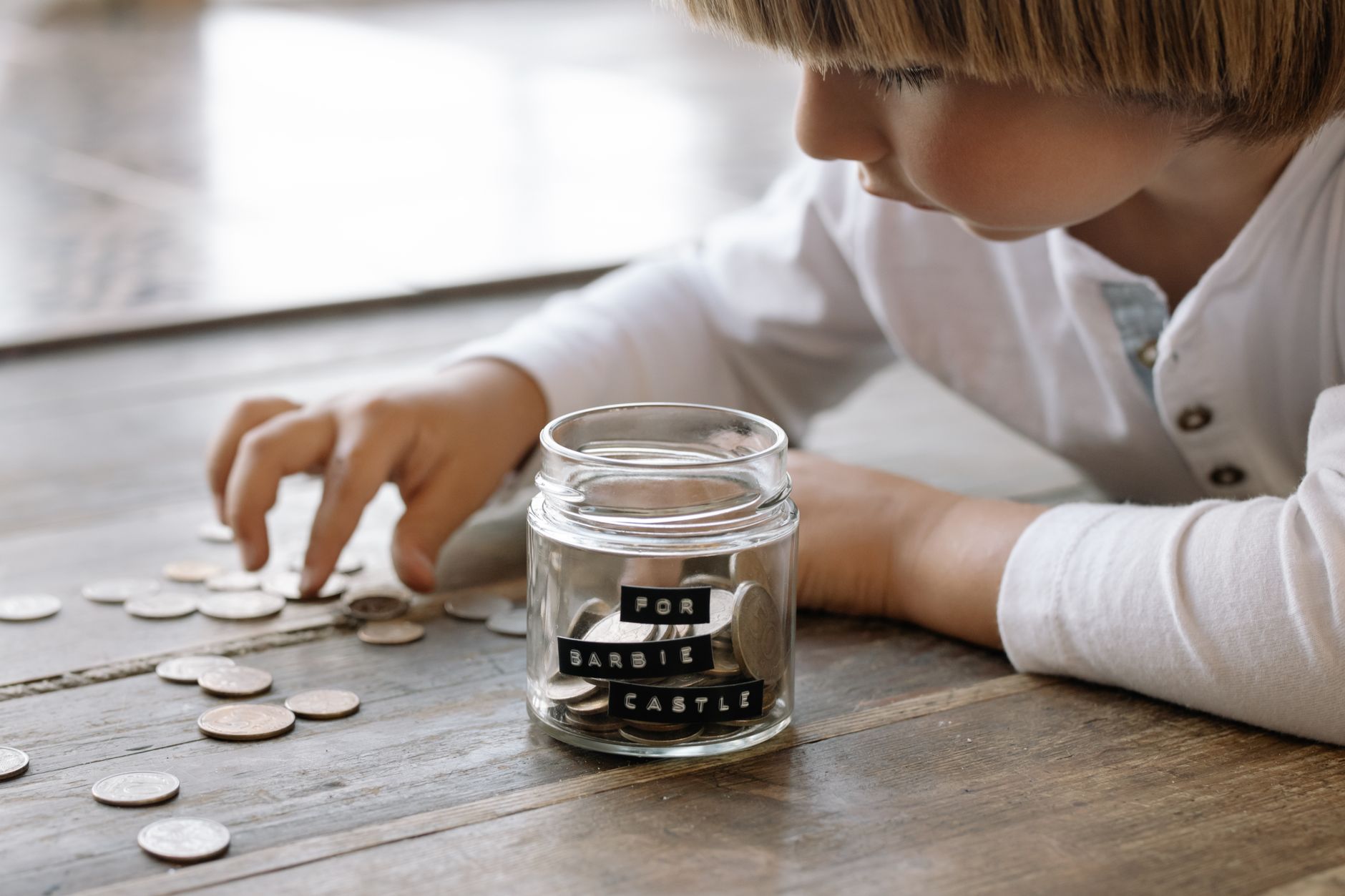
Dump a jar of mixed coins on the table. Ask your child to sort them by size, then by color, then by the pictures on them. Once they're sorted, name each coin together: penny, nickel, dime, quarter.
Then make it a game: "Which pile has the most coins? Which pile is worth the most money?" (Spoiler: the dime pile often surprises kids — it's smaller than a nickel but worth more.)
This single activity teaches value, comparison, and the counterintuitive truth that bigger doesn't always mean more. That's a lesson adults still struggle with.
Level up: Give them a simple price tag (a sticky note that says "5¢") and ask them to count out the right coins. Making change comes later — for now, just counting to a target is plenty.
The Three-Jar System for Little Hands
The three-jar system is the single most powerful money habit you can build at age five. It's simple: every time your child receives money — allowance, birthday gift, tooth fairy — they divide it into three jars labeled Spend, Save, and Give.
The split doesn't have to be perfect. Even a rough 70/20/10 works. What matters is the habit of dividing — not spending everything the moment it arrives.
Use clear jars so they can see the money growing. Watching coins pile up is motivating in a way that a bank app balance never is for a 5-year-old. When the Save jar gets full, you can open a real savings account together — that's a milestone moment.
Our free Money Kit includes printable jar labels, a savings tracker, and a parent guide that walks you through the whole system — designed specifically for ages 5–10.
Start the Three-Jar System Today
Our free Money Kit includes printable jar labels, a savings tracker, and a step-by-step parent guide — everything you need to set up the system this weekend.
Get the Free Money Kit →Pretend Store Play at Home
Set up a "store" on your kitchen table using items from around the house — a toy, a snack, a book. Put sticky-note price tags on each item (keep prices simple: 5¢, 10¢, 25¢). Give your child a small amount of coins and let them "shop."
This activity teaches budgeting in the most natural way possible: they have a limited amount, they have to choose, and they can't buy everything. That's the entire concept of scarcity — learned through play.
Rotate the "shopkeeper" role. When your child runs the store, they practice making change and counting money from the other side. Both roles build different skills.
Variation: Use a toy cash register if you have one. The physical act of pressing buttons and hearing the "cha-ching" makes the experience feel real and memorable.
Grocery Store Money Games
The grocery store is one of the best real-world classrooms for money. Before you go, give your child a small "budget" — even $2 in coins — and let them pick one item to buy with it.
While you shop, play the "price is right" game: hold up two similar items and ask which one costs more. Let them guess before you show them the price tags. This builds price awareness — a skill that pays off for decades.
You can also narrate your own decisions out loud: "I'm choosing the store brand because it's $1 cheaper and tastes the same. That's $1 we can save." Kids absorb these micro-lessons without even realizing it.
Check out our post on how to teach kids about spending wisely for more real-world strategies you can use on everyday errands.
For ages 5–8
Money Seeds — The Complete Financial Curriculum
40 illustrated pages teaching earning, saving, and giving through activities kids actually want to do. The 3-Jar System in depth. Savings goals they set themselves.
See Money Seeds — $17 →Earning Money Through Simple Chores
Connecting money to effort is one of the most important lessons a 5-year-old can learn. A small allowance tied to age-appropriate chores does exactly that.
Good chores for 5-year-olds: putting toys away, setting the table, feeding a pet, sorting laundry by color, wiping down low surfaces. Keep the list short — two or three tasks per week is plenty.
Pay immediately after the chore is done, in physical coins. The immediacy matters. A 5-year-old's sense of time is short — a week feels like forever. Paying right away reinforces the cause-and-effect connection between work and reward.
Some families separate "household contributions" (unpaid, because we all pitch in) from "earning chores" (paid, optional extras). Either approach works — what matters is that your child experiences earning, not just receiving.
Setting a First Savings Goal
Ask your child: "Is there something you really want?" It might be a toy, a book, or a special outing. Whatever it is, look up the price together and write it on a piece of paper.
Then make a simple savings tracker — a rectangle divided into boxes, one box per coin or dollar needed. Every time they add to their Save jar, they color in a box. Watching the tracker fill up is powerfully motivating.
When they reach the goal, take them to buy it themselves. Let them hand over the money. That moment — paying for something they saved for — is one they'll remember. It's the first time money feels like something they control, not just something adults have.
According to Investopedia's research on delayed gratification, children who learn to wait for a larger reward develop stronger financial habits as adults. A savings goal at age 5 is the earliest version of that skill.
Money Books That 5-Year-Olds Love
Books make abstract concepts concrete — and there are some genuinely great ones for this age group. A few favorites:
- Alexander, Who Used to Be Rich Last Sunday by Judith Viorst — a relatable story about spending money too fast
- The Berenstain Bears' Trouble with Money — classic, covers earning and saving
- Bunny Money by Rosemary Wells — shopping, budgeting, and making choices
- A Chair for My Mother by Vera B. Williams — saving toward a family goal, beautifully told
Read these together and pause to ask questions: "What would you have done with Alexander's dollar?" or "Why do you think the bunnies ran out of money?" The conversation after the book is where the real learning happens.
For a deeper look at age-by-age money milestones, see our guide on how to teach a 5-year-old about money — it covers what concepts to introduce and when.
Give Your 5-Year-Old a Real Head Start
The Money Seeds workbook is built for ages 5–8 — 40 pages of earning, saving, and giving activities your child can do right now.
Explore Money Seeds →Putting It All Together: A Simple Weekly Routine
You don't need to do all twelve activities at once. A simple weekly rhythm is more effective than an occasional money marathon. Here's what that can look like:
- Monday: Assign the week's earning chores
- Friday: Pay allowance in coins, divide into jars together
- Weekend: One money activity — store play, a book, or a grocery game
- Monthly: Count the Save jar together and update the savings tracker
That's it. Twenty minutes a week, consistently, builds more financial confidence than any one-time lesson ever could. The goal at age five isn't mastery — it's familiarity. Money should feel normal, not mysterious.
The parents who tell us their kids are "naturally good with money" almost always started early — not because their kids were born that way, but because money was just part of how their family talked and lived.
Frequently Asked Questions
What money concepts can a 5 year old understand?
Five-year-olds can grasp that money is earned, that different coins and bills have different values, that we choose between spending and saving, and that giving is part of how money works. Keep it concrete — physical coins, real choices, and simple jars work best at this age.
How do I introduce money to a 5 year old?
Start with real coins and a simple sorting game. Let them handle money, count it, and make small real purchases. Pair physical experience with a three-jar system (Spend, Save, Give) so they see money as something with purpose — not just something adults carry.
Should a 5 year old get an allowance?
Many child development experts say yes — a small weekly allowance (even $1–$2) gives kids a real-world lab to practice decisions. The goal isn't the amount; it's the habit of receiving, dividing, and choosing what to do with money.
What are the best money games for 5 year olds?
Coin sorting, pretend store play, the "price is right" guessing game at the grocery store, and simple board games like Monopoly Junior are all excellent. The best games involve real or realistic money and real choices — not just memorizing facts.
How much allowance should a 5 year old get?
A common guideline is $0.50 to $1 per year of age per week — so $2.50 to $5 per week for a 5-year-old. More important than the amount is consistency and the habit of dividing it into Spend, Save, and Give jars.
This article may contain affiliate links. WealthSprout earns a small commission if you purchase through our links, at no extra cost to you. We only recommend products we believe in. Nothing in this article constitutes financial advice — see our Financial Disclaimer.
Start this weekend →
The financial education your child deserves starts with one decision.
Download the free Money Kit — 12 pages, instant delivery, takes one Saturday morning. Or explore the full age-matched curriculum at wealthsproutkids.com.
✓ Instant digital delivery · ✓ Works on any device · ✓ Print at home · ✓ 30-day guarantee